
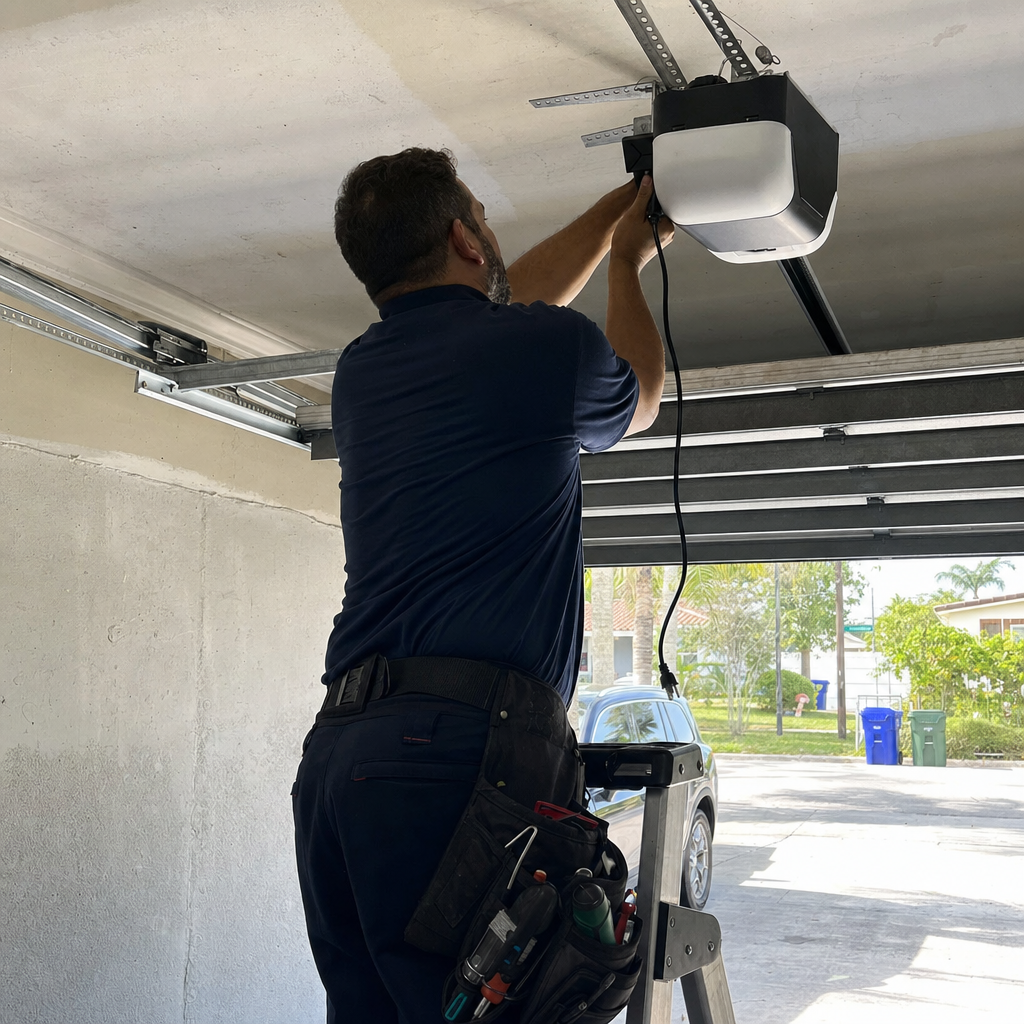
Last updated June 21, 2026
Seasonal Garage Door Care for Fort Lauderdale: Year-Round Homeowner’s Guide
Most garage door maintenance guides are written for climates that get cold winters and dry springs. Fort Lauderdale gets neither. What we get instead is a two-season swing — a dry stretch that runs roughly November through April, followed by a humid, storm-heavy season that doesn’t fully let go until October. That pattern puts specific, repeating stress on every garage door in this city, and if you’re maintaining yours on a Midwest schedule, you’re probably doing the right tasks at the wrong time. This guide is built around how Fort Lauderdale weather actually behaves — and what that means for your hardware, your opener, and your door’s ability to hold up when a named storm rolls through.
Quick Answer
In Fort Lauderdale, seasonal garage door maintenance is organized around three climate phases: the dry season (November–April), pre-hurricane prep (April–June), and active storm season (July–October). The dry season is your primary maintenance window — low humidity lets lubricants cure properly and lets you accurately assess what summer stress did to your springs, tracks, and panels. Skipping dry-season maintenance and heading into June unprepared is the most common reason Fort Lauderdale garage doors fail during the first major storm of the year.
Table of Contents
- Dry Season (Nov–Apr): Your Primary Maintenance Window
- Salt Air and Coastal Corrosion: It Affects You Even a Mile Inland
- Pre-Hurricane Prep (April–June): Getting Your Door Wind-Load Ready
- Active Storm Season (July–Oct): Managing a Door Under Repeat Stress
- Year-Round Opener Care in South Florida’s Heat
- Hardware Choices That Hold Up in Fort Lauderdale’s Climate
- Common Mistakes to Avoid
- When to Call a Professional
- Frequently Asked Questions
- The Bottom Line
Dry Season (Nov–Apr): Your Primary Maintenance Window
November through April is the single most important stretch for garage door maintenance in Fort Lauderdale — not because the weather is punishing, but because it’s the only window where conditions are actually right to do the work correctly. Relative humidity drops enough that white lithium grease and silicone-based lubricants can penetrate metal surfaces and cure without immediately being diluted or displaced by airborne moisture. If you try to lubricate a torsion spring in August, you’re fighting the air itself.
The dry season is also when you can clearly read the damage summer did. Heat expansion and contraction cycles, repeated moisture exposure, and any storm stress from the previous season all show up as bent tracks, worn rollers, fraying cables, and springs that have started to lose tension. Those problems don’t announce themselves loudly — they show up as a door that takes a half-second longer to respond, or a section that doesn’t sit quite flush anymore.
Dry-Season Inspection Checklist
- Check torsion and extension springs for visible rust, gaps in the coil, or uneven tension. In Fort Lauderdale’s year-round humidity, spring corrosion is a faster process than in drier climates.
- Lubricate all moving parts — hinges, rollers, torsion spring coils, and the track brackets. Use a silicone-based spray or white lithium grease. Avoid WD-40 on springs; it strips the protective coating rather than lubricating.
- Inspect panels for warping or water intrusion. Steel panels from brands like Clopay and Amarr hold up well here, but any denting from last season’s debris can allow moisture to wick into the panel seams.
- Test the auto-reverse safety mechanism by placing a 2×4 flat on the ground under the door and triggering the close cycle. The door should reverse on contact.
- Examine the bottom weather seal. South Florida’s standing-water events will push water under a cracked or compressed seal. Replace it if it no longer holds a consistent seal against the floor.
- Tighten all hardware. Track bolts, roller brackets, and hinge screws vibrate loose over a season of daily cycling. A quarter-turn with a socket wrench takes five minutes and prevents a track separation later.
- Test manual release. Pull the red emergency cord and manually lift the door. It should travel smoothly and hold at waist height. If it drops, spring tension is insufficient — this needs professional adjustment before storm season.
Salt Air and Coastal Corrosion: It Affects You Even a Mile Inland
Fort Lauderdale sits on the Atlantic coast, and salt-laden air moves inland farther than most homeowners expect. Properties directly on the Intracoastal Waterway or along Fort Lauderdale Beach face the most aggressive corrosion conditions, but in our experience, homes as far inland as Lauderdale Lakes and Tamarac still show accelerated corrosion on untreated steel hardware compared to what you’d see in a non-coastal city of the same humidity level.
Salt air attacks exposed steel in two ways: it accelerates oxidation directly, and it attracts moisture that stays on the metal surface long after a rain event has dried. The result is rust that develops from the inside out — especially on torsion spring coils, which have thousands of closely wound turns that trap salt particles between them.
What to Do About It
- Wipe down exposed hardware after storms using a dry cloth, then follow with a light coat of silicone spray. Don’t skip this step if your garage faces east or northeast.
- Specify marine-grade or galvanized hardware when replacing any component. If you’re in the Victoria Park neighborhood, Harbor Beach, or anywhere east of US-1, this isn’t optional — it’s the baseline.
- Upgrade to stainless steel or powder-coated rollers when your nylon rollers wear out. The stock rollers in most new doors aren’t rated for coastal environments.
- Check cable ends at the drums and bottom brackets annually. Cable fraying from corrosion at the anchor points is one of the most common hardware failures we see on Fort Lauderdale homes within a half-mile of water.
- Consider a steel door with a factory-applied rust-inhibiting finish if you’re replacing panels. Wayne Dalton and Clopay both offer coastal-grade finish options that are meaningfully different from their standard product lines.
Pre-Hurricane Prep (April–June): Getting Your Door Wind-Load Ready
Florida’s hurricane season officially begins June 1, but named storms have made landfall in South Florida as early as May, and the pre-season prep window — April through the end of May — is when Fort Lauderdale homeowners should be specifically testing their door’s ability to perform under wind load, not just its ability to open and close normally.
A garage door that operates perfectly in a 10 mph breeze can flex, buckle, or jump its tracks in a sustained 80 mph wind event. The difference between a door that holds and one that fails isn’t just the door’s rated wind resistance — it’s whether the door’s hardware is properly tensioned, whether the tracks are straight and secure, and whether any pre-existing damage has been left unaddressed going into the season.
Pre-Hurricane Prep Steps
- Verify your door’s wind-load rating. Florida Building Code requires garage doors in Broward County to meet specific wind pressure ratings. If your door was installed before 2002 or replaced without permit, it may not meet current Broward County wind-resistance standards. Check the sticker on the inside of the door — it should list a design pressure (DP) rating.
- Inspect horizontal and vertical tracks for straightness. A track that’s bent even a quarter-inch can cause a door to derail under lateral wind pressure. Run a straightedge along the track face or visually sight down it from the end.
- Check that all track mounting bolts into the structural header are tight. Wind load transfers through the tracks to the header bracket. If those bolts are loose, the track system can pull out of the wall before the door itself fails.
- Test the door’s manual operation. If power goes out during a storm and your door won’t release manually, you may be stuck inside. Confirm the emergency cord works and the door moves freely.
- Inspect hurricane bracing if installed. Some Fort Lauderdale homes have horizontal bracing bars that drop into brackets across the door sections. Confirm they’re accessible, undamaged, and that every bracket is still anchored to a door stile — not just to the panel skin.
- Do not try to weatherstrip against a Category 2+ storm with standard bottom seals. Wind-driven rain at storm intensity will push water past any consumer-grade seal. The goal pre-hurricane is door integrity, not perfect water exclusion at the threshold.
Active Storm Season (July–Oct): Managing a Door Under Repeat Stress
The July–October window in Fort Lauderdale isn’t just hurricane season — it’s daily afternoon thunderstorm season, sustained high-humidity season, and the period when your garage door takes cumulative punishment from repeated minor stress events. A door that came through a named storm without visible damage may still have shifted track alignment, loosened hardware, or a stressed spring from repeated pressure cycles during multiple storm passes.
During active storm season, the maintenance posture shifts from prevention to monitoring. You’re not doing full service in August heat — you’re watching for the warning signs that signal something needs attention before the next event.
What to Monitor During Storm Season
- Listen for new sounds. A grinding or popping noise that wasn’t there a month ago is hardware moving that shouldn’t be. Rollers that have shifted in their track, or a hinge that’s cracked, will make noise before they fail.
- Watch for uneven closing. If one side of the door reaches the floor before the other, a cable may have stretched unevenly or a drum may have shifted on the torsion bar.
- After any named storm, walk the exterior. Look for dented panels, debris that may have jammed under the bottom seal, and whether the door sits flush against the stop molding. Storm pressure can bow a door slightly so that it no longer seals against the weatherstrip on the sides.
- Don’t defer broken spring replacement. A single broken spring during storm season — when you may need to evacuate quickly or secure your home on short notice — is an urgent repair, not a “get to it next week” item. If your opener is struggling to lift, or the door only opens partway, don’t assume it’s the opener.
- Acceptable temporary fixes vs. what needs immediate service: Tightening loose bolts yourself is fine. Replacing a worn bottom seal yourself is fine. Adjusting or replacing springs, cables, or drums is not a DIY task — the stored energy in a torsion system can cause serious injury if released without the correct tools.
Year-Round Opener Care in South Florida’s Heat
Garage door openers fail faster in Fort Lauderdale than in most U.S. cities. That’s not a scare tactic — it’s physics. Motor-driven devices that cycle in a space where temperatures regularly exceed 100°F in summer (a closed South Florida garage can hit 130°F on an August afternoon) age their capacitors, circuit boards, and drive mechanisms measurably faster than the same unit running in a 75°F garage in the Carolinas.
LiftMaster and Chamberlain units — the two most widely installed brands in Broward County homes — both offer models with built-in thermal protection that cuts the motor before it overheats. If your opener is more than eight years old and lacks that feature, summer heat alone may be shortening the remaining life by 30–40%. Genie and Craftsman units in the mid-price range show similar heat sensitivity.
Opener Maintenance by Season
- Dry season (Nov–Apr): Clean the photo-eye sensors with a dry cloth — they accumulate a fine film of construction dust and pollen that causes false obstruction readings. Test both the close and open limits. Confirm the force adjustment hasn’t drifted, which happens as drive gears wear.
- Pre-hurricane (Apr–Jun): Test the battery backup if your unit has one. LiftMaster’s 8550W and similar backup-equipped models are common in Fort Lauderdale, but backup batteries lose charge capacity over time. A battery that holds a charge in November may not complete three cycles after a 24-hour power outage.
- Storm season (Jul–Oct): After any extended power outage, reconnect the opener and run three full open-close cycles before relying on it. Re-engage the trolley from manual mode by running the opener with the door fully closed. Some openers — especially older Craftsman chain-drive units — don’t re-engage cleanly after manual operation.
- Ventilate your garage if possible. A louvered vent or a small wall-mounted exhaust fan can reduce the peak temperature in a closed garage by 15–20°F. That single change can meaningfully extend opener lifespan in Fort Lauderdale homes without attached AC.
If you’re evaluating a replacement, our Garage Door Opener in Fort Lauderdale page covers which units hold up best in South Florida’s specific heat and humidity conditions.
Hardware Choices That Hold Up in Fort Lauderdale’s Climate
Not all garage door hardware is built for coastal South Florida conditions. Standard steel components that perform fine in Atlanta or Dallas can show visible corrosion within two years here. When you’re replacing rollers, hinges, springs, or an entire door system, the material and finish choice matters more in Fort Lauderdale than it does almost anywhere else in the continental U.S.
Material Recommendations by Component
- Springs: Specify oil-tempered springs with an applied corrosion-resistant coating — many suppliers now offer galvanized or zinc-plated torsion springs that carry a meaningfully longer service life in coastal environments. Standard black springs in a Coral Ridge or Lauderdale-by-the-Sea home can show surface rust within 18 months.
- Rollers: Nylon rollers with sealed steel bearings are the right choice for Fort Lauderdale — the nylon body resists corrosion, the sealed bearing keeps moisture out, and they run noticeably quieter than steel rollers. Raynor and several aftermarket suppliers spec these as standard in their coastal-rated door packages.
- Panels: Steel doors with a factory polyurethane foam core (available through Clopay, Amarr, and Wayne Dalton’s premium lines) insulate better than non-insulated steel but, more relevantly for Fort Lauderdale, the foam backing reduces the rate of interior condensation on the panel skin — which is a corrosion driver from the inside out.
- Bottom seal: An astragal-style T-bottom seal seats more reliably on uneven concrete than a standard bulb seal. Given how many Fort Lauderdale driveways show surface settling over time, the T-seal maintains contact across minor gaps that a bulb seal will bridge unevenly.
- Track hardware: Powder-coated or hot-dip galvanized track brackets are worth the premium if your home is within a mile of the water. Standard zinc-plated brackets from residential kits are adequate inland but show accelerated pitting near the coast.
If you’re at the point where a new door installation makes more sense than continued repairs, the Garage Door Installation in Fort Lauderdale page covers current panel options, pricing ranges, and what the permit process looks like in Broward County.
Common Mistakes to Avoid
- Using WD-40 on torsion springs or rollers. WD-40 is a solvent and moisture displacer, not a long-term lubricant. On spring coils, it strips the oil-temper coating and accelerates rust. Use white lithium grease or a silicone-based spray formulated for garage door hardware.
- Skipping dry-season maintenance because the door “seems fine.” In Fort Lauderdale, a door that survived summer without an obvious failure often has hardware that’s one storm away from a problem. The dry season is when you find that out on your terms, not during a June squall.
- Ignoring the wind-load rating on an older door. Homes built in the 1980s and 1990s in neighborhoods like Riverland, Edgewood, or Lauderdale Manors often still have pre-code doors that don’t meet Broward County’s current DP ratings. An unreinforced door in a wind event can cause structural damage to the garage opening itself — not just to the door.
- Replacing only the broken spring without inspecting the pair. Torsion springs are installed and wear as a system. If one spring breaks after 10,000 cycles, the other is at the same wear point. Replacing one and leaving the other is a short-term fix that usually results in a second service call within months.
- Running the opener on a door with a broken spring. An opener is rated to assist a balanced door, not to lift a door’s full dead weight. Running your LiftMaster or Chamberlain opener when a spring is broken will strip the drive gears or burn the motor — turning a $250 spring repair into a $400–$600 opener replacement.
- Deferring a bent track because the door still opens. A door that opens on a bent track is running on borrowed time. The track deformation concentrates load on one or two rollers, which fail suddenly rather than gradually. In South Florida storm season, a track failure during manual operation — when you need to quickly secure your home — is a serious problem.
- Applying fresh paint over rusted hardware without treating the rust first. This is common in Fort Lauderdale’s coastal neighborhoods where homeowners try to preserve the appearance of aging track brackets or hinge plates. Paint over rust seals in moisture and accelerates corrosion from beneath. Wire-brush to bare metal, apply a rust converter, and then prime before any topcoat.
When to Call a Professional
Some garage door maintenance is genuinely homeowner-appropriate — wiping down sensors, tightening visible bolts, replacing a bottom seal, keeping hardware lubricated. But several situations in Fort Lauderdale require a trained technician, not because the tasks are complex in concept, but because the physics of a loaded torsion system makes them dangerous if you don’t have the right tools and training.
Call a professional when: a spring has broken or you can see a gap in the spring coil; cables are fraying or have come off the drum; the door is off its tracks; the opener is running but the door isn’t moving; you have visible panel damage after a storm and the door doesn’t close flush; or your door was installed before 2002 and you’re not certain it meets Broward County’s current wind-load code.
For any of these situations — and for annual dry-season tune-ups — the team at Peak Garage Door Repair Fort Lauderdale is the right call. William Rodriguez has been servicing Fort Lauderdale doors for seven years and handles every job personally. Call (754) 225-7593 for a free estimate.
Frequently Asked Questions
How often should I lubricate my garage door in Fort Lauderdale?
Lubricate springs, rollers, hinges, and track brackets twice per year — once during the dry season (November through January is ideal) and once in early spring before humidity returns. Fort Lauderdale’s year-round humidity means lubricants break down faster here than the annual schedule recommended in most owner’s manuals, which are written for drier climates. Use white lithium grease or a silicone-based spray; apply sparingly and wipe off any excess that would attract dust onto the track surface. Call (754) 225-7593 if you’d like a full tune-up done right — estimates are free.
Do Fort Lauderdale garage doors need to be hurricane-rated?
Yes. Florida Building Code and Broward County local amendments require garage doors to meet specific design pressure (DP) ratings based on the home’s location and exposure category. Doors installed before 2002 frequently don’t meet current standards. The required DP rating varies — homes closer to the coast in Fort Lauderdale face higher wind pressure requirements than properties farther inland. If you’re not sure whether your door is compliant, the rating label is on the inside face of one of the door sections. If the label is missing or unreadable, a professional inspection will tell you what you have. Call (754) 225-7593 for an assessment.
Why does my garage door opener fail more often than my neighbors’ in other states?
Heat is the primary driver. A sealed residential garage in Fort Lauderdale can reach 120–130°F on a summer afternoon, which accelerates capacitor degradation, circuit board fatigue, and drive mechanism wear on all opener brands. LiftMaster and Chamberlain units with thermal cutoff protection handle this better than budget chain-drive models. If your opener is cycling sluggishly in summer or throwing thermal fault codes, the unit may need replacement — or the garage simply needs better ventilation to reduce peak temperatures.
Can I do garage door maintenance myself, or do I need a professional for everything?
You can safely handle lubrication, sensor cleaning, bolt tightening, bottom seal replacement, and visual inspections. Do not attempt to adjust or replace torsion springs, rewind springs, replace cables, or reset drums — these components store significant mechanical energy and require specialized winding bars and training to work on safely. In Fort Lauderdale’s storm season, a DIY spring adjustment gone wrong isn’t just a repair cost; it can be a serious injury. If there’s any doubt, call a professional.
How do I know if my garage door was damaged by a storm even if it still opens?
Test it in manual mode first — disconnect the opener and try to lift the door by hand. It should travel smoothly and hold at waist height without effort. Then run the full open-close cycle with the opener and watch for uneven travel, listen for new grinding or popping sounds, and check that all four corners of the door meet the stop molding and floor seal evenly. After any named storm in Fort Lauderdale, also walk the exterior and look at whether the door sits plumb and flush in the opening — wind pressure can bow the door frame slightly, leaving gaps that weren’t there before.
What’s the best garage door brand for Fort Lauderdale’s coastal environment?
For the Fort Lauderdale market, Clopay’s Coastal Collection and Wayne Dalton’s 9700 series are built specifically with corrosion resistance in mind. Amarr also offers steel doors with a Kynar-finish option that performs well in high-salt environments. The door material matters less than the hardware it’s installed with — marine-grade or galvanized track hardware, sealed-bearing nylon rollers, and a coated torsion spring will outlast standard components by years in any Fort Lauderdale neighborhood east of I-95. For help choosing, our Garage Door Repair in Fort Lauderdale page covers the hardware decisions that come up most in our service work.
The Bottom Line
Fort Lauderdale garage door maintenance is a three-phase discipline, not a once-a-year checkbox. The dry season is your window to lubricate, inspect, and fix what summer broke. Pre-hurricane prep is when you verify the door’s mechanical integrity under wind load — before you need to depend on it. Storm season is when you monitor, not improvise, and know which repairs are safe to defer and which aren’t. Salt air affects homes farther inland than most owners realize, opener heat degradation is faster here than the national average, and the right hardware choices up front prevent most of the repeat failures we see. Nearly 800 Fort Lauderdale homeowners have trusted William Rodriguez and Peak Garage Door Repair with their doors over the past seven years — because straight answers and owner-level accountability matter more than a franchise logo.
Ready to Schedule Your Seasonal Maintenance?
Whether you’re heading into dry-season service, preparing for hurricane season, or dealing with a door that’s showing signs of storm stress, William Rodriguez handles every job personally — from the estimate to the final test cycle. Peak Garage Door Repair Fort Lauderdale offers free estimates and carries parts for every major brand on the market, including LiftMaster, Chamberlain, Genie, Clopay, Amarr, Wayne Dalton, Craftsman, and Raynor. Call (754) 225-7593 to schedule — no dispatch queue, no subcontractors, just the owner showing up with the right tools.
Written by William Rodriguez, Owner & Lead Technician at Peak Garage Door Repair Fort Lauderdale, serving Fort Lauderdale since 2019.