
Last updated June 21, 2026
Garage Door Repair Maintenance Checklist for Fort Lauderdale Homeowners
We pull corroded torsion springs out of Fort Lauderdale garages that are only 18 months old. The national recommendation to lubricate your garage door once a year doesn’t account for what salt air and 90% humidity do to bare metal inside a non-climate-controlled garage six blocks from the beach. The checklist in this guide isn’t copied from a manufacturer pamphlet written in Ohio — it’s built around what actually fails here, in this climate, on this coast. By the end, you’ll know exactly what to inspect, when to inspect it, which products to use, and which tasks to hand off to a professional before someone gets hurt.
Quick Answer
Fort Lauderdale homeowners should perform a visual inspection of their garage door every 30 days and a full lubrication service every 3–4 months — not the 6–12 months recommended in most national guides. Salt air, high humidity, and the annual hurricane prep window create a maintenance calendar that looks nothing like the rest of the country. Staying on this schedule is the single most effective way to avoid emergency repair calls and extend the life of springs, cables, and hardware by several years.
Table of Contents
- Why Fort Lauderdale’s Climate Changes Everything
- Month-by-Month Maintenance Calendar for South Florida
- The 5-Minute Visual Inspection That Catches 80% of Problems
- Which Lubricants Actually Work in High Humidity (and Which Make Things Worse)
- Pre-Storm Checklist: What to Do Before a Named Storm Hits
- What You Can Do Yourself vs. What You Shouldn’t Touch
- Common Mistakes Fort Lauderdale Homeowners Make
- When to Call a Professional
- Frequently Asked Questions
- The Bottom Line
Why Fort Lauderdale’s Climate Changes Everything
Every garage door manufacturer publishes a maintenance schedule. Almost none of them are calibrated for coastal South Florida. The combination of factors that Fort Lauderdale throws at a garage door — salt-laden air, humidity that rarely drops below 65% even in the dry season, afternoon thunderstorms from May through October, and the occasional named hurricane — creates a corrosion and wear environment that is genuinely different from most of the country.
Salt air is the most underappreciated factor. Homeowners in Rio Vista, Harbor Beach, or Lauderdale Harbors — neighborhoods within a mile or two of the Intracoastal or the Atlantic — are dealing with salt deposition on exposed metal parts every single day. Torsion springs, cable drums, hinges, and roller bearings all have metal-on-metal contact points where salt accelerates oxidation rapidly. We regularly see galvanized torsion springs that show visible rust pitting before they’ve completed a full year of service in these locations.
Inland neighborhoods like Lauderdale Lakes, Tamarac-adjacent areas, and parts of the I-595 corridor see slightly less direct salt exposure — but humidity-driven corrosion is still a factor, and the afternoon storm season puts just as much water into garages through gaps and floor drainage as it does anywhere else in Broward County.
The practical takeaway: anything a national checklist tells you to do once a year, plan to do it three to four times a year here. The maintenance cost is low. The repair cost — a snapped torsion spring, a frayed cable, a seized roller — is far higher, and the timing is always inconvenient.
Month-by-Month Maintenance Calendar for South Florida
South Florida doesn’t have four seasons in the traditional sense. For garage door maintenance purposes, think in terms of three windows: dry season (November–April), storm season prep (April–June), and active wet season (June–October). Here’s how to align your maintenance to those windows.
Dry Season: November through April
- November: Full lubrication service — springs, cables, rollers, hinges, and tracks. This is the best time because humidity is at its seasonal low and lubricant penetrates and adheres better to clean metal.
- January: Visual inspection. Check for rust spotting on springs and cables, listen for new grinding or squeaking during a full open/close cycle, test auto-reverse safety function.
- March: Second lubrication of the year. Inspect weather stripping — the bottom seal takes a beating from Fort Lauderdale’s afternoon rain events and UV exposure and typically needs replacement every 18–24 months.
Storm Season Prep: April through June
- April/May: Pre-hurricane season structural check. Inspect all mounting hardware — lag bolts on the horizontal tracks, spring anchor bracket bolts, and cable drum set screws. Tighten anything that has worked loose over the year. Test the manual disconnect cord on your opener.
- June: Final check before the peak of hurricane season. Confirm the emergency release works smoothly, inspect the bottom panel for water damage, and verify weather stripping seals completely when the door is closed.
Active Wet Season: July through October
- August: Mid-season lubrication. This is the most-skipped service interval, and it’s one of the most important. Rain drives moisture into every exposed component. A dry torsion spring in August is a spring working its way toward failure.
- October: Post-storm-season inspection. Check for any rust progression, water infiltration damage to the bottom section or panels, and wear on the rollers and cables after months of humidity exposure.
The 5-Minute Visual Inspection That Catches 80% of Problems
You don’t need tools for this. Stand in your garage with the door closed, then run through this sequence. Do it once a month and you’ll catch the majority of developing problems before they become emergency calls.
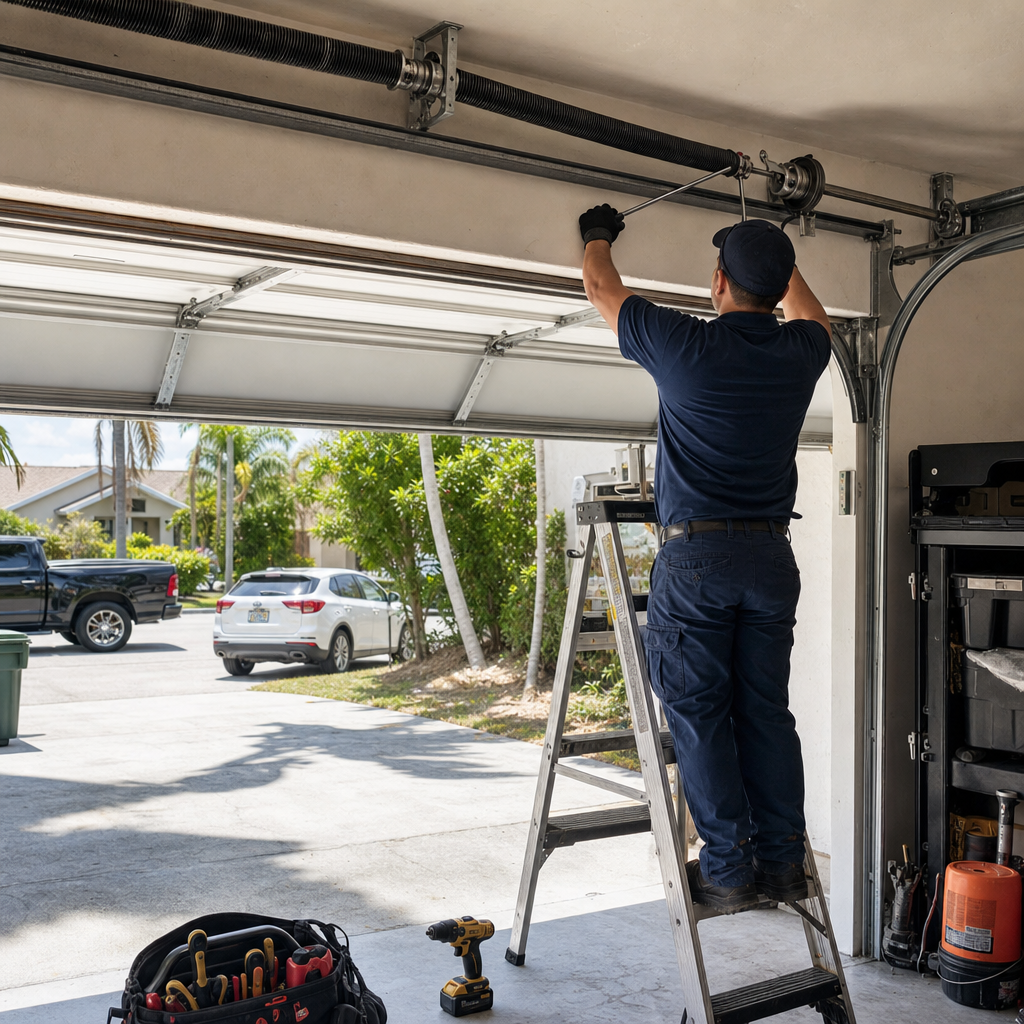
- Look at the torsion spring. It runs horizontally above the door, mounted on a steel bar. Look for rust spots, gaps in the coils (a broken spring will have a visible separation), or any coils that look stretched or irregular compared to the rest.
- Trace both cables. The lift cables run from the bottom corners of the door up to the cable drums. They should be taut, evenly wound, and free of fraying or kinking. A frayed cable is a cable preparing to snap — don’t wait on this one.
- Check the rollers. Each roller rides in a track on either side of the door. Look for cracked nylon wheels, rollers that have jumped the track, or roller stems that are visibly bent. Worn rollers are a common culprit for the grinding noise homeowners describe.
- Inspect the tracks. Run your eye along the vertical and horizontal track sections. Look for visible bends, gaps at the seam brackets, or debris that has collected in the track channel. A bent track is repairable early; if the door rides it long enough, it can damage the door panels too.
- Test the balance. Pull the red emergency disconnect cord to put the door in manual mode. Lift the door by hand to about waist height and let go. A balanced door stays put. One that falls or rockets upward has a spring tension issue that needs professional attention.
- Operate the opener. Reconnect and run a full open/close cycle. Listen for anything that’s changed — new grinding, hesitation, or a door that reverses unexpectedly. On LiftMaster, Chamberlain, or Genie openers, check that the force limit settings haven’t drifted; temperature swings affect these.
Which Lubricants Actually Work in High Humidity (and Which Make Things Worse)
This is where a lot of well-intentioned DIY maintenance goes sideways in Fort Lauderdale. The wrong lubricant in a humid, salt-air environment doesn’t just fail to protect — it can actively attract dirt, trap moisture against metal, and accelerate the corrosion you were trying to prevent.
Use These
- White lithium grease (aerosol): The correct choice for torsion springs, hinges, and cable drums. It adheres well to metal in humid conditions, doesn’t run off in heat, and doesn’t attract particulate the way heavier oils do. Apply directly to the coils of the spring, not just the surface.
- Silicone-based spray lubricant: Best for tracks, nylon rollers, and the weather stripping channel. Silicone doesn’t degrade rubber or plastic the way petroleum-based products can, and it sheds water rather than absorbing it — important in a climate where humidity is the baseline condition, not the exception.
- Penetrating oil (like PB Blaster or similar) for seized hardware only: If a bolt or hinge pivot is locked up, a penetrating oil breaks it free. But don’t use it as a maintenance lubricant — it’s too thin to stay in place, and it’ll attract every dust particle in your garage.
Avoid These
- WD-40 as a primary lubricant: WD-40 is a water displacer and light solvent, not a durable lubricant. It evaporates quickly, especially in heat, and leaves metal bare and vulnerable within weeks in a South Florida garage. Using it on springs is a common mistake we see constantly.
- Grease-based lubricants on tracks: Heavy grease in the tracks catches debris and creates a gritty grinding paste over time. The track surface should be clean, not coated.
- Motor oil or general-purpose oil: Both run in heat, pool at the bottom of components, and create a mess that attracts rust-accelerating particulate.
Pre-Storm Checklist: What to Do Before a Named Storm Hits
This section matters more in Fort Lauderdale than almost anywhere else. A garage door is the largest and most wind-vulnerable opening in most homes. Getting this wrong before a storm isn’t just a property damage issue — in extreme cases, it’s a structural issue, because a garage door failure can allow pressure equalization that compromises the entire roof system.
What to Do
- Confirm your door is wind-rated. If you’re not sure, look for a sticker on the inside of the door near the bottom panel. Broward County building code has required impact-rated or wind-load-rated garage doors on new construction since 2002. If your door predates that and hasn’t been replaced, this is worth confirming before storm season, not during it.
- Inspect and tighten all mounting hardware. The track mounting brackets, torsion spring anchor bracket, and opener rail bracket should all be tight. Vibration from a season of operation works bolts loose over time. A half-hour with a socket set before a storm is time very well spent.
- Test the manual disconnect. Pull the red cord and confirm the door moves freely by hand. You may need to operate your garage door manually if power is out — know that it works before the storm, not after.
- Clear the area in front of the door. Patio furniture, potted plants, and anything else that can become a projectile should be moved well away from the door face and stored inside or secured.
- Check the bottom seal. It should compress fully against the floor across the entire width of the door. Any gap larger than about ¼ inch is going to let water in. For a Clopay, Amarr, or Wayne Dalton door, replacement bottom seals are generally available and straightforward to install.
What NOT to Do
- Don’t engage the manual lock bar on an electric opener door. Many garage doors have a manual slide lock that was designed for doors operated without an opener. Engaging it on a door connected to an opener motor creates a situation where the opener can fight the lock and damage both. If you’re preparing for a storm, disconnect the opener and rely on the door’s deadbolt-style lock if it has one, or brace it according to manufacturer guidance.
- Don’t assume a newer door is automatically hurricane-rated. Impact rating and hurricane certification are specific designations. Confirm yours rather than assuming.
- Don’t leave the door partially open. Some homeowners believe a slightly open door equalizes pressure. Structural engineers and building codes disagree — a partially open door is worse than closed in a high-wind event.
What You Can Do Yourself vs. What You Shouldn’t Touch
This is a genuine safety conversation, not a sales pitch. Certain garage door components store significant mechanical energy under tension — enough to cause serious injury when that energy releases unexpectedly. The goal here is to keep homeowners safe and capable, not to make every task seem dangerous.
Reasonable DIY Maintenance Tasks
- Monthly visual inspections using the sequence above
- Lubricating springs, hinges, rollers, and tracks with the correct products
- Replacing the bottom weather seal (most models use a simple T-slot or nail-on design)
- Testing and replacing opener batteries and wall button connections
- Cleaning and clearing debris from track channels
- Programming remote controls and keypads on LiftMaster, Chamberlain, Craftsman, or Genie systems
- Adjusting the travel limit and force settings on an opener (with the manufacturer manual in hand)
Call a Professional — Don’t Attempt These
- Torsion spring replacement or adjustment. A torsion spring is wound to store hundreds of foot-pounds of torque. An uncontrolled release can cause severe lacerations, broken bones, and eye injuries. The special winding bars and the technique required are not something to improvise. This is the single most injury-prone DIY task in the garage door trade.
- Cable replacement. Lift cables are under tension from the springs. Removing or re-routing a cable while the spring is loaded puts you in the same risk zone as spring work itself.
- Track realignment beyond minor adjustments. If a track has a significant bend or has come off its mounting bracket, the door’s full weight may be involved in the correction. Misaligned repairs here can cause a door to come off track mid-operation.
- Bottom section replacement on a door under spring tension. The bottom section carries the cable anchor bracket. Removing it without properly securing the spring tension first can cause the spring to unwind violently.
After seven years and nearly 800 service calls across Fort Lauderdale and Broward County, the emergency calls that involve the most serious situations — property damage and the occasional injury — trace back almost exclusively to DIY spring or cable attempts. The repair cost for a professional torsion spring service is far less than an emergency room visit.
Common Mistakes to Avoid
- Lubricating on a national schedule instead of a local one. Following a once-a-year schedule in Fort Lauderdale means your springs and cables are running dry for 8–9 months of the year during some of the most humid and corrosive conditions in the country. Move to every 3–4 months.
- Using WD-40 as a substitute for a proper lubricant. It evaporates within weeks in a hot garage, leaves metal bare, and creates a false sense of having completed the task. It’s fine as a first step to loosen a seized bolt — it’s not a garage door lubricant.
- Ignoring small rust spots on torsion springs. Surface rust on a coil spring is not cosmetic — it’s a stress concentration point. A spring that shows pitting in January is a spring that may snap in August. Catch it early, address it early, or plan for an emergency call at the worst possible time.
- Skipping the balance test for years at a time. An unbalanced door puts constant extra load on the opener motor. On a LiftMaster or Genie unit, that extra strain shortens the motor’s lifespan measurably. The balance test takes 30 seconds.
- Letting the bottom seal go too long between replacements. In Fort Lauderdale, the combination of UV exposure and ozone from proximity to the coast degrades rubber bottom seals faster than in inland climates. A failed seal lets water in during every afternoon storm, which means the floor is wet, the air in the garage is wetter, and every metal component corrodes faster. Plan on inspecting it annually and replacing it when it no longer compresses flush.
- Engaging the manual lock bar when an opener is installed. As noted in the hurricane prep section, this is a common pre-storm mistake that can strip gears or damage the opener trolley. Disconnect the opener properly instead.
- Waiting for audible failure before calling for service. A door that grinds, hesitates, or shudders is telling you something specific. Those symptoms rarely resolve on their own and almost always get worse. Acting on early signs of wear costs a fraction of what a full emergency repair does.
When to Call a Professional
Call immediately if you see a gap in your torsion spring coils — that’s a broken spring and the door should not be operated until it’s replaced. Call the same day if you notice a cable that’s visibly frayed, kinked, or off the drum. Both of these situations involve stored mechanical energy that makes continued DIY operation genuinely dangerous.
Schedule a professional inspection if your door has started reversing on its own, if it hesitates noticeably during operation, or if the balance test shows it won’t hold position at mid-travel. These symptoms point to spring tension loss, opener force calibration issues, or roller/track wear — all of which are straightforward to address early and significantly more disruptive once they reach failure.
If your door took any direct impact — a car bump, windblown debris, or storm damage — get a structural assessment before continuing to operate it. A panel that looks superficially intact can have internal frame damage that affects cable geometry.
Peak Garage Door Repair in Fort Lauderdale offers free estimates on repair and maintenance work — call (754) 225-7593 to schedule. William Rodriguez performs the assessment personally, so the person who quotes the job is the person who does it.
Frequently Asked Questions
How often should I lubricate my garage door in Fort Lauderdale?
Every 3–4 months — significantly more often than the 6–12 month schedule most national guides recommend. Fort Lauderdale’s combination of salt air, high humidity, and intense UV exposure depletes lubricants and accelerates corrosion at a rate that makes once-a-year service inadequate. Use white lithium grease on springs, hinges, and drums, and silicone spray on the tracks. Call (754) 225-7593 if you’d like a professional lubrication and inspection service — the estimate is free.
What type of garage door holds up best to Fort Lauderdale’s humidity and salt air?
Steel doors with a factory-applied polyurethane or polyester finish, or fiberglass and aluminum-faced doors, resist salt-air corrosion better than bare or lightly primed steel. Clopay and Amarr both manufacture doors with corrosion-resistant coatings specifically suited to coastal climates. Whatever material you choose, the hardware — springs, cables, and hinges — needs regular lubrication regardless, because even the best door panel won’t protect internal components from humidity. For options, see our Garage Door Installation in Fort Lauderdale page.
Is my garage door hurricane-rated, and how do I check?
Look for a compliance sticker on the inside of the lowest panel or near the bottom corner of the door. It will reference a Florida Product Approval (FPA) number and wind load rating. Broward County has required wind-rated doors on new construction since the post-Andrew building code revisions — but older homes and replacement doors installed before 2002 may not meet current standards. If you can’t find the sticker, the door’s age and permit history are the next things to check. This is worth confirming before hurricane season, not during a storm watch.
Can I replace a garage door torsion spring myself?
We strongly advise against it. Torsion springs store hundreds of foot-pounds of torque under tension. Without the proper winding bars, technique, and experience, the risk of the spring releasing suddenly — causing severe lacerations or broken bones — is real and well-documented. This is the single component in a garage door system where we consistently discourage DIY attempts. A professional torsion spring replacement in Fort Lauderdale is typically completed in under an hour, and the cost is a fraction of what a preventable injury costs. Call (754) 225-7593 for a free estimate.
How do I know if my garage door opener needs to be replaced or just serviced?
Most opener issues — reversing unexpectedly, intermittent response, slow travel — are caused by force settings, sensor alignment, or worn drive components, not a failed motor. On LiftMaster, Chamberlain, Genie, and Craftsman units, these are adjustable and often fixable without replacement. Replacement becomes the practical answer when the motor itself has failed, the drive mechanism is stripped beyond repair, or the unit is old enough that parts are no longer available. Our Garage Door Opener in Fort Lauderdale page covers this in more detail. A professional diagnosis will tell you quickly which category you’re in — and we won’t push a replacement if a repair is the right call.
What’s the most common garage door repair in Fort Lauderdale?
Broken torsion springs, by a significant margin. The accelerated corrosion environment here means springs fail earlier than their rated cycle life in most cases — especially in homes within a mile of the Intracoastal or the ocean, like parts of Victoria Park, Lauderdale-by-the-Sea adjacent areas, or beachside Fort Lauderdale neighborhoods. The second most common call is cable issues, typically fraying or coming off the drum. Both are preventable with consistent lubrication and early detection during monthly visual inspections.
The Bottom Line
The maintenance schedule that works in Chicago or Phoenix doesn’t work in Fort Lauderdale. Salt air, sustained humidity, afternoon storms, and annual hurricane prep create a different set of priorities and a faster service interval. The short version: inspect monthly, lubricate every 3–4 months with the right products, prep your door before storm season, and don’t attempt torsion spring or cable work yourself. A door that gets consistent attention stays out of the emergency call category — and in this climate, that’s not a given without it.
Nearly 800 Fort Lauderdale homeowners have trusted William Rodriguez and Peak Garage Door Repair Fort Lauderdale with their garage doors over the past seven years. If your door needs a professional eye — or if you’d just like to confirm everything is in order before storm season — call (754) 225-7593 for a free estimate. The person who picks up is the same person who shows up.
Written by William Rodriguez, Owner & Lead Technician at Peak Garage Door Repair Fort Lauderdale, serving Fort Lauderdale since 2019.